Tuesday, February 28, 2012

Curls

Any person with no knowledge whatsoever of training who walks into the gym will do curls, I guarantee it. Curls is just the first thing people associate with weight training. When people ask you to flex, you immediately show off your biceps.

I've seen people literally spend an hour training their biceps. They'll do some straight barbell curls, followed by some dumbbell hammer curls, followed by some preacher curls, and finally finish off with Arnold's 21s or whatever the hell they're called (you people know who you are).

I've seen people so fixated with curls that they neglect to train the other parts of their body, so they can't even get the barbell off the ground to curl it, and they need someone to help bring the bar into the starting position. That's just messed up.

If you're a beginner, honestly you're better off doing pull-ups and chin-ups. These exercises will train your back as well as your biceps, so you get an exercise that gives you more bang for your buck. What's going to cause your body more stress? A bodyweight + 40kg pull-up or a 30kg barbell curl? Quite frankly if you can't even do pull-ups you have no business curling. Do pull-ups and chin-ups if you're not already. If your gym has those pull-up bars with different grips, use them all, switch the grip for each set. If you can't do pull-ups here's now to progress.

Start off with 10 sets of 1 rep, space out the sets enough that you can perform all the reps properly with good form. Next time increase the reps on all the sets, so 10 sets of 2 reps. The next session do 10 sets of 3 reps, etc etc. until you reach 10 sets of 5 reps. Time to move onto weighted pull-ups. Feel free to switch grips for each set. Put on a weight belt and increase the weight by 1.25kg each time, doing 3 sets of 5 reps. Again switch grips with each set if you like. Once you can do pull-ups for bodyweight + 20kg for 3 sets of 5 reps you should be smart enough about your training to know if its time to do curls or not. As you get stronger, you may want to change the rep ranges, like 3x8 weighted in the first week, 5x5 in the second week and 2x5,3x3 in the third week.

Bigger guys weighing 90kg and over will have a harder time doing pull-ups but that's no excuse to not do them, just watch Konstantinovs (you don't need to exaggerate the leg swing as much as him).

If you can't even do a single pull-up, there's several things you can try.
  • Negatives: holding the pull-up bar, jump into the top position then slowly lower yourself down.
  • Elevate your feet on a box then do pull-ups this way, so you'll be lighter, similar to this image but you can use a higher box if you need to. As it gets easier, put less of your weight on the box so you'll be pulling more of your own bodyweight.
  • Use a bit of leg swing to help with the pull-ups.
  • Get strong on barbell rows because they train the back also.
  • Stay away from assisted pull-up machines. They don't reinforce proper technique so you can be doing assisted pull-ups with bad technique, which won't be useful once you try normal pull-ups.

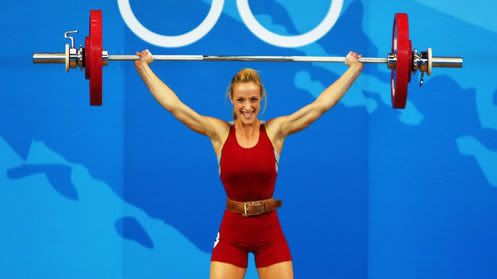
If she can do a pull-up you have no excuse.

Remember, compound movements are superior for overall growth, and isolation exercises are used to fill in the little details. And also, if you want to put on muscle, you need to gain weight. There's a famous quote that says "A good rule of thumb is that for every inch you want to gain on your arms, you need to gain roughly 15 pounds of equally distributed body mass." You actually need to gain weight if you want bigger arms, back, legs, chest, etc.

I don't mean splurge on food and gain 10kg of bodyweight in a month. I've heard a skinny guy say "I'm going to bulk for 3 months then do a cut". More like he needs to bulk for 3 years. Heck, that's what I've been doing. You're body can only produce muscle at a certain rate. As a beginner this may be pretty damn quick at the start, but don't expect it to be this way for too long. It's called the law of diminishing returns:
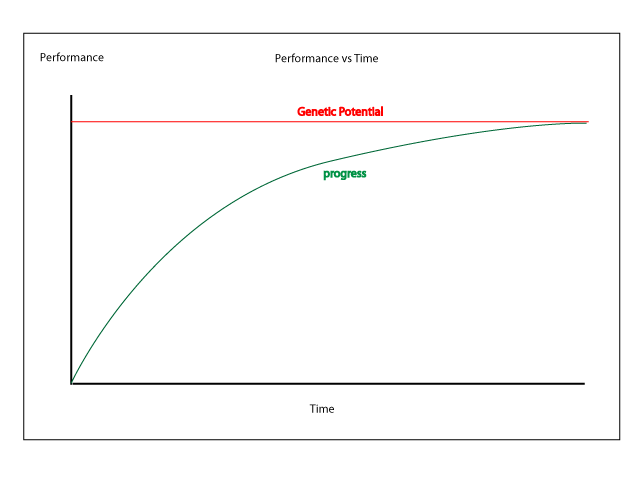
Basically you have a ceiling, known as your genetic potential. As you get closer to it, it'll become harder and harder to make progress.

Once you're past the honeymoon period of training, you actually need to think about how you're training and recovering (eating and sleeping). Your muscle will also only be able to produce muscle at a certain rate. Let's use the construction of a building as an analogy. The building is your muscle. The materials that come in to be used to construct the building is your food intake. If too much material comes onto the construction site, there will be extra material sitting around unable to be used, this is your body fat. So what you want to do is order in a suitable amount of materials to come onto site, so that the building can be built at a steady pace, but also so that you don't have too much extra materials laying around for nothing.

So what this means is that you want to be eating enough to build muscle, but not so much that you're piling on the body fat. I guess the analogy above only covered diet. In terms of training, compound movements will be the main structure of the building, and isolation exercises will be fine details like pretty architecture. What do you think needs to be focused on first?

Another thing, the leaner you are (the less bodyfat you have on your body), the better your insulin sensitivity which will make it easier to put on muscle. So keep an eye on your body and watch how it responds to your weight gain. If you're packing on the belly fat, lower the food intake a bit. If you're not gaining after a month increase the food intake.

If you're just starting out with weight training and you already have some size on you (over 80kg at 170cm say), just focus on getting stronger. Your body will take care of itself. If your body fat levels are pretty high though, back off in your food intake slightly but not so much that you feel weak in the gym. Adjust accordingly. Make sure you're getting stronger.

For skinny guys, ignore the above paragraph. Focus on getting stronger, and eating more than you are now. The reason you're in this position now is because you're not eating enough, clearly. Read my other post on diet. And if you have abs, they most likely will fade when you gain weight. But you have to give a little to gain a lot. Just keep your body fat levels in check whilst gaining weight and it won't be too difficult to lose the extra fat once you're happy with your size which I can guarantee won't be for a while if you're skinny.

Another thing, don't be so fucking self conscious if people say you've gotten fatter. Chances are you haven't done a good job gaining weight if that's happened since your bodyfat levels shouldn't be too high, but either way, that doesn't mean its time to give up on your goals. Never lose sight of what you're trying to achieve.

So what if he has abs? He couldn't win a fight against my little sister

One more thing, training your triceps is also important for your arms since they make up two-thirds of your upper arm. And by training your triceps I don't mean fucking tricep kickbacks, I mean the bench press, overhead press and heavy-ass weighted dips.


A great exercise for the chest, shoulders and triceps


Sources:

http://www.t-nation.com/free_online_article/sports_body_training_performance/the_truth_about_bodybuilding_arm_measurements;jsessionid=FADA1D443AC4E8405268B931FB438DD3-mcd01.hydra

Saturday, February 18, 2012

The Truth...and Other Things

This post didn't turn out like how I originally planned, but here goes...

There are no shortcuts. Accept this fact now while it's still early. There's no such thing as getting ripped quick in 3 weeks. You won't get a ripped chest or massive arms in six weeks, even with steroids. Anyone who claims that there are shortcuts or secrets to achieving a dream physique is most likely trying to sell you something. You've probably come across websites where you enter in your email to receive a free training handbook that doesn't give too much away, then at the end of the book there's a link to a website which advertises another book that you have to buy, which contains what the writer claims to be the revolutionary method of training, with a whole bunch of testimonials to back it up. You might think what's the point, well the point is that there will be some people out there who will fall for it. Alot of the times, the writer may have simply written what worked for him, but that doesn't always mean the same thing will work for you. Only you can figure out what works for you and what doesn't and this will take years of consistent training.

I've seen another example where the article talks about a different style of training that is apparently more effective, then near the end of the article it talks about how you won't get amazing results without using a certain supplement too. Everyone's gotta bring home the bread I guess. Click on the last page of these articles to see what I'm talking about:

http://www.t-nation.com/free_online_article/sports_body_training_performance/i_bodybuilder_radical_strategy_for_radical_hypertrophy&cr=

http://www.t-nation.com/free_online_article/most_recent/look_like_a_bodybuilder_perform_like_an_athlete&cr=


To prevent getting sued...

*DISCLAIMER* I am not actually saying these products do not work, they actually might. The results the writers claim to be possible may actually be real.

------

Society has gotten lazier. People want shortcuts, they want the results without putting in the hard work. That's why you'll see most ads using phrases like 'get ripped quick' or '2 weeks to a 6 pack' or something like that. Hard work, optimal recovery and consistency is what will bring you results.

Supplements may or may not help you get better results, but they are not a substitute for hard work. I honestly don't think they're as good as how they're hyped up to be. I take whey protein because I want some extra protein without the carbs, since my diet is pretty high in carbs at the moment (a must if you're trying to get bigger). I don't take whey protein because I'm under the impression that it'll make me massive in 3 weeks. See the difference? If you're going to use certain supplements you better know exactly why you want to take it and what it does. Don't think that supplements will magically transform your body or make you ridiculously strong in a short amount of time or that you don't have to train hard and consistently.

------

Honestly, I don't think there's a perfect routine, just what works for you for the time being. What you're doing now may be slightly different to 6 months or 12 months down the track, based on your needs. What you're doing now may be very different to 2 years down the track.


Arnold and Franco trained differently. Don't bother following these guy's routines, you're not at their level. Those routines were based on what their needs and goals were.

I fell for the trap of jumping to another program for the wrong reason once my current one stopped working. What I failed to do was analyse why it had stopped working.

My bench press and press had stalled (at around 75kg and 47.5kg respectively) when I was on SL5x5, but what I failed to do was record form videos of myself. So I didn't know that it was actually my technique that was holding me back. But anyway, I thought that since I wasn't able to recover in time, it was time to move onto a new program (called Madcow5x5 or Bill Starr5x5) with less volume (the sets are ramped, kinda like a pyramid so you work up to one heavy set of 5 reps), where I increased the weight each week instead of every session. While this gave me some results, it eventually stopped working (my bench got up to about 80kgx5, and my press got up to 50kgx5, not much of an improvement). Even after deloading and working my way back up I got stuck at a slightly higher weight, barely any improvement. After making some improvements to my technique, my bench increased slightly to 85kgx5 and 90kg for a single.

I then switched to the Texas Method, which involved training for volume (5x5) on Monday, and intensity on Friday (1x5). My bench press got up to 88.5kgx5 then stalled, my press increased to 60kgx3 (but could still make progress). I asked myself why the hell was my bench press stalling so easily? I decided that based on the weights I was handling, I simply was not benching heavy often enough. I was not stressing my body enough to even drive an adaptation. (It was either that or 'overtraining', which was very unlikely).

I decided to go back to linear progression (increasing the weight every session), however instead of 5x5 I did 3x5 for the bench press and 5x3 for the press. Did it work? Yes. My bench press improved to 91kg 3x5 (still continuing to improve) and my press improved to 66kg 5x3 (still continuing to improve). I'm on my way to achieving a bodyweight overhead press just from doing linear progression, nothing fancy. The numbers may not seem much higher but bare in mind I'm doing more sets. Will this work forever? No, but it's working for me now and that's the point. Don't get the wrong idea, I'm not bashing the routines I mentioned above but they simply did not work well for me. I'm actually doing Texas Method for squats at the moment which is working wonderfully (my 5RM increased from 152.5kg to 170kg). You should also note that even though I did a bunch of routines that didn't work too well, I stuck to them for a few months so that I knew for sure whether they worked or not. Don't expect to know if something is working for you after just 2 weeks.

I don't expect many of you to understand much of what I talked about, but an important thing I learnt was that volume is important. Once you stall (as in cannot progress even after deloading), the solution isn't to do the lift less, but to do the lift more. The same thing happened to my squat and deadlift. They eventually stalled (literally no improvement even after deloading twice), but once I upped the volume the ball got rolling again. Don't think that switching to a totally new program is going to solve all your problems.

I got a bit sidetracked, there's one more thing. Even if you were on a fantastic routine which was tailored toward your goals, if you didn't put in the hard work and ensure optimal recovery (eating plenty, getting enough sleep) don't expect to achieve the results you were expecting. Busting your ass in the gym is important, but recovering from it is more important, because that's how your body gets stronger.


Conclusion:
  • If you're stalling too easily, or when you stall and deload but see no improvement, what you are doing is not working well anymore. Time to make a change.
  • If you make a change, give it time (a few months) so you'll know for sure if its working or not.
  • You need more volume the more advanced you get.

Friday, February 17, 2012

How to Perform the Main Lifts Part II

Continuing on from the previous post, I will cover how to do the deadlift and overhead press.

Deadlift


  • Make sure you are wearing shoes with a thin sole. This way all the force you exert gets transferred to the bar, if you wear running shoes they will absorb some of the force, and also reduce your stability.
  • First you need to find your foot stance. Jump then land and see where your feet end up. That's your foot stance.
  • Load plates on the bar. Its pointless to deadlift the empty bar. Make sure you're using the 20kg barbell, don't use those set weight barbells that you see people curling with. The reason for using the 20kg barbell is obvious, so that you can add weight to the bar.
  • You will need to make sure that the bar is at the correct height off the ground. Usually the 20kg plates in your gym will be the correct height off the ground. If you're not strong enough to start with the 20kg plates, put 5kg or 10kg plates on the bar, then stack some plates on the ground and place the loaded barbell on the stacks. This will make the bar the correct height. You can also do this if the 20kg plates at your gym are smaller than normal. Watch this video to see how I deal with this problem. The bar should be near the middle of your shins or a bit lower.
  • The bar needs to be at the correct height because if it is too low, it'll be harder to not round your back.

This bar is not high enough off the ground

  • Approach the bar and take the jumping foot stance, jump again near the bar if you need to.
  • Looking down at the bar, make sure the bar cuts your foot in half. This ensures the bar will be over the middle of your foot, which is where it needs to be. If the bar was over your toes when you lift the bar off the ground it'll eventually end up over the mid-foot so you might as well start with the bar in that position so that you don't waste effort that could've gone to lifting the bar.
  • Bend down and grab the bar, with a hand width that allows your hands to clear the knees (not too close and not too wide, but as close as you can manage if that makes sense).
  • Make sure you are gripping the bar with a full grip; the thumbs must not be on the same side as your fingers or else you risk the bar falling out of your hands.
  • Make sure your chest is up, this will prevent you from rounding your back.
  • Make sure your hips are neither too high nor too low. You will know if they're too low if they suddenly rise up when you initiate the pull like in this video. Your hips will be too high if your legs are not involved in the lift because they straighten out too early, and you mainly feel it in your lower back and hamstrings when you pull like in this video. After enough practise you will find the position that feels good for you.
  • Keep your neck in a neutral position at all times, no need to look up at the ceiling.
  • Take a big breath into your diaphragm. Your chest shouldn't rise if you do this correctly.
  • 'Pull' the bar off the ground by thinking about pushing your feet into the ground. A lot of people make the mistake of pulling the bar with their back which can result in pronounced rounding which can be dangerous. Watch this video for an extreme case of someone pulling with their back. Use your legs people, don't think about the deadlift as a pull (even though technically it is)!
  • As the bar passes your knees, drive your hips forward by squeezing your glutes (think about holding a card between your butt cheeks) to bring the bar to lockout position.
  • To set the bar back down, reverse what you did to lift the bar up. Shoot your hips back then as the bar passes your knees, bend the knees to set the bar back on the ground.
  • Breathe into your diaphragm between each rep when the bar is on the ground. Never let go of the bar until the set is over. This will build grip strength.
  • Once you get the hang of the technique, the deadlift is the easiest of the lifts to learn.

Overhead Press


  • Make sure the bar is set at the same height that you use for squatting.
  • Grip the bar at a width where your forearms will be perpendicular to the ground. If this is hard to do because you have long forearms, try to grip as close as you can manage so that the bar can still rest on your chest when you unrack the bar. Don't grip the bar too wide because it places your triceps at an unfavourable angle. Your triceps should be touching your lats if you are using the correct grip width. From the side view, your elbows should be in front of the bar.
  • Make sure the bar is sitting in the palms of your hands close to your wrists (and not close to your fingers) so that your wrists won't be bent when you press (a common mistake you see people do).
  • Unrack the bar and take two steps back. Take a comfortable foot stance, it'll be a bit narrower than your squat stance. Too wide a foot stance and you won't feel as stable.
  • Try to point your chest to the ceiling, this will contract your upper back.
  • Flex your lats as hard as possible, this will give you a stable base to press from.
  • Squeeze your glutes at all times during the set. This will give additional stability.
  • Take a big breath into your diaphragm then press the bar up. Don't let the bar travel forwards otherwise you will waste energy bringing the bar back to the correct path. Don't lean back excessively either, try to maintain an upright posture. Think about aiming for your face (but don't actually hit your face), this will keep the bar path as vertical as possible.
  • As the bar passes your forehead, lean your torso forwards and let your hips move back slightly. This is known as 'getting under the bar'. Doing this will make locking out the bar easy.
  • Once you are at the lockout position, lower the bar back down to your shoulders. Don't forget to move your head back out of the way. Make sure your chest is up once the bar is at the bottom position again. A lot of people forget to keep the chest up after the first rep.
  • Pause for a second, take a big breath then press again.
  • Rack the bar by walking to the stands then lowering the bar onto the pins.
  • As you get more proficient at maintaining the chest up position when the bar returns to the chest everytime as well as pressing the bar up in a vertical path, you may wish to press as soon as the bar touches the chest (similar to the bench press). This allows you to use the stretch reflex so you will be able to handle more weight. If you choose to press this way, how you breathe will be slightly different. For the first rep you will breathe when the bar is on your chest, then once you have locked out the bar at the top, take a quick breath then lower the bar and as it touches your chest press again. Then once again breathe at the top. Do this until the set is over.
  • If your ceiling is too low, you may wish to do the press seated. You might need a spotter to hand you the bar however. If the ceiling is high enough I would recommend doing the movement standing though.
  • The press trains the shoulders more effectively than the bench press (which only hits the front of the shoulders), so in some ways it is a better exercise than the bench press even though you cannot use as much weight. Don't neglect this exercise, getting strong at the overhead press will help your bench press also.

Final Notes:

Gripping the bar correctly. When you are pressing (overhead press and bench press), the bar needs to be sitting in your palm closer to your wrists. If the bar is too close to your fingers your wrists will be bent and you will lose some efficiency in pressing.

When you are pulling (deadlift, barbell rows), the bar needs to be closer to the fingers. Gravity will pull the bar into this position anyway. If you grip the bar too close to your wrists, the bar will squash the skin in your hands and you will get unpleasant calluses. Watch this informative video about gripping the bar.

Also you may notice in some of my videos I'm wearing a belt. This is just to allow me to engage my abs more since they are pushing into the belt, as a beginner you don't need to worry about wearing a belt. You need to first practise bracing your abs properly without a belt. If you can't do this properly then wearing a belt won't benefit you.

Wednesday, February 15, 2012

How to Perform the Main Compound Lifts

If you haven't read this post already, check it out first:

http://derickthai.blogspot.com.au/2012/01/introduction-to-strength-training-part.html

This post will highlight some useful cues beginners can use on the main compound lifts.

Squat (low bar)

Here's me squatting 170kg for 5 reps.


Here's another video of Justin Lascek squatting with better form than me.


  • Make sure the pins is set so the bar (when racked) is where the middle of your chest is. This will make it easier to unrack and rack the bar. If you have to go on your tip-toes to rack the bar after your set, the pins are set too high.
  • The bar must be sitting above your scapula; watch this video if you're not sure about where this is. *Highly recommended!*
  • Place the bar too low on your back and you risk the bar sliding down which can be dangerous.
  • Grip the bar with a width as narrow as you can manage. This will contract your upper back muscles, which will provide a stable 'shelf' for the bar to sit on.
  • Make sure your chest is up at all times, this will prevent you from rounding your back when squatting.
  • Position yourself under the bar, ensuring that the bar is placed in the correct position on your back. Once the bar is firmly set on your back, raise your elbows high enough that the bar is being pushed into your back. No need to raise your elbows to the point where your arms are parallel to the ground. Forearm length will determine how high your elbows actually will be.
  • Ease the bar off the safety pins, then take two steps back.
  • Feet should be a bit wider than shoulder width apart. This will make it easier to shove the knees out when you're in the hole (bottom position of the squat).
  • Before each and every rep, take a big breath into your diaphragm (think about breathing into your stomach). Your chest should not expand when you breath this way. Watch my stomach in the video of me squatting above when I breathe.
  • When you squat down, make sure you break at the hips and knees simultaneously.
  • Make a conscious effort to keep your knees out at all times during the squat. Watch the above video of Justin squatting again to see this being performed. This will make it easier to get into the bottom position, and also prevents the buckling in of the knees during the ascent which can cause knee problems.
  • During the descent, think about 'sitting back' like you're about to sit onto a chair or toilet.
  • Make sure you know how it feels to be in the bottom position, where the hip joint is slightly below the knee joint when viewed from the side. Practise being in this position with just your body so you can get a feel for this.
  • Once you've hit the bottom position, immediately come out of the hole. It should almost look like a bounce.
  • When coming out of the hole, think about driving up with your hips. A lot of people make the mistake of leading with their chest, but try think about leading with the hips. This will allow you to use hip drive. Watch this video to see hip drive being taught.
  • Make sure you don't exhale at all until you're almost at the top. Holding your breath will keep your abs braced which will increase your stability.
  • Squeeze the glutes (imagine trying to hold a card between your butt cheeks) as you near the lockout (finish position of the squat).
  • When racking the bar, simply walk forwards until the bar touches the rack then set the bar down on the pins. That is why the pins must be set at the position I described above, so that racking the bar is easy.
  • A final note about shoes, avoid squatting in running shoes. The soles of running shoes are compressible, and so you can't apply as much force to the bar since some of it gets absorbed by the shoes. You also won't be as stable as you could be if you were squatting in a pair of shoes that have a hard sole, such as weightlifting shoes (I use them), or Chucks, or shoes with a very thin sole. If you're not convinced, imagine yourself squatting barefoot in a jumping castle, compared to squatting barefoot on concrete, in which case would you be able to apply more force?

Bench Press

Here's me benching:


Here's a video of Justin Lascek warming up on the bench press:


  • First lay on the bench. Grip the bar at your preferred grip width. Now lift your upper body up towards the bar and retract your shoulder blades, then plant your upper back firmly into the bench, maintaining this retraction of the shoulder blades. Watch this video to see how this is done. If you watch my video, you'll see how I initially put my feet on the bench, and raise my entire body up, including lifting the butt off the bench. What this does is put all my bodyweight on my upper back once I push the upper back into the bench. You want to feel this pressure on your upper back, because it ensures you have a solid base to press from.
  • Now put your feet back on the ground, and let your butt touch the bench, ensuring you are still maintaining the pressure on your upper back, as well as the shoulder blade retraction. Now ease your feet backwards (in the direction of where your head is) whilst also pushing your butt up the bench (towards your head). What this does is it helps to set an arch in your back. An arch is useful for benching because it places your back in a stronger position (ignore the people who say you'll hurt your back benching like this), and it will also reduce the distance the bar has the travel since the bar will touch your chest earlier. Watch this video to see more about the arch. The arch should be big enough that someone can fit their arm between you back and the bench.
  • Do not let your feet move around during the set. The final position of my feet result in my shins being behind vertical (watch the video of me benching above). How far back you place your feet will come down to personal preference, but make sure your feet are planted back far enough that you feel tightness in your quads. The reason for doing this is that you will be able to engage your lifts more effectively in the lift this way, a technique known as leg drive (I will elaborate on leg drive in another post). Planting your feet back will also reduce the chance of your butt coming off the bench during the set (known as bridging) because the height of your knee will be lower than the hip. Don't bridge because it's cheating!
  • You should feel slightly uncomfortable, but very tight. If someone were to give you a light nudge you shouldn't budge. This tightness will make you stronger at bench pressing. Over time as your flexibility improves you may choose to make a bigger arch in your back.
  • Make sure the bar is set at a height where your arms can unrack the bar fully extended with locked elbows/ The reason for this is that you are strongest when your elbows are locked, so should any incident occur whilst you are unracking or racking the bar, provided that your elbows are fully locked you can minimise any possible harm which may occur to yourself. If you're not aware of it by now, the bench press is the most dangerous of the main compound lifts.
  • Move the bar down towards your feet (but not too far down) and also behind your head (but not too far back). Do this with an empty bar obviously. Try to find the position where the bar feels almost weightless, or where you feel strongest. This is the optimal lockout position for you. In this lockout position, memorise where the bar is with respect to the ceiling. Keep your eyes fixed at this point at all times during the set. You will be pressing the bar back to this position every time.
  • Bring the bar down to where your nipples are, or slightly below. Don't bring the bar to your stomach, that is too low. Don't bring the bar down high up on your chest either. If you do this, your elbows will be flared out (at 90 degrees to your body) which will place your shoulders in a compromising position. You see a lot of people benching like this, and from a mechanically standpoint this position may seem most optimal, however you risk causing shoulder impingement or rotator cuff injuries which is not worth it.
  • Just before the bar is about to touch your chest, think about 'driving up'. In other words, think about pressing the bar up before you are actually going to. This will allow you to control the descent of the bar, so it doesn't fall to your chest too quickly. Once the bar touches your chest, explode upwards. Make sure the bar returns to the point your eyes are fixed upon. You want to press the bar as forcefully as you can, as this will recruit more muscle fibres. Pressing your warm up weights forcefully will also make the heavy weights not seem as heavy. "Lift light weights like heavy weights and lift heavy weights like light weights" as Ed Coan famously states. This applies to all exercises.


Don't bench like this unless you want to kill your shoulders.


I'll talk about the overhead press and deadlift in another post, otherwise this post will be way too long.

Monday, February 13, 2012

Why Full Body Routines Are Superior for Beginners Part II

When you use compound lifts, the muscle groups work together, and thus grow together. However, when you train the muscle groups separately, there's a risk of some muscle groups falling behind. A lot of beginners who train this way, often favour certain muscle groups over others, particularly the beach muscles (what you can see in the mirror; chest, biceps, quads). This is bad because neglecting the other muscles (rear delts, upper back, hamstrings) can result in bad posture (shoulders hunched forward) and some serious muscle imbalances which leave the trainee prone to injuries.

There is just something about the way the compound lifts make the body grow, that cannot be mimicked by isolation exercises.

This guy clearly doesn't deadlift, his neck and traps are lagging behind

When you train the compound lifts, you don't have to worry about muscle groups being in proportion or whatnot. You just need to worry about getting strong on the compound lifts. Put as much effort into all your lifts and you won't have to worry about looking out of proportion. If you have short arms, you'll be better at benching and pressing, but deadlifting will be harder. If you have long arms, you'l be better at deadlifting but not as good at benching and pressing. But don't let your genetics stop you, worry about getting as strong as you possibly can.

Why do shrugs, leg curls, leg extensions, wrist curls and back raises when you can do deadlifts? No need for front raises, laterial raises and rear delt raises when you can do the overhead press. Get more out of doing less, training economy is your friend.

Jim Wendler clearly lifts heavy

Jim above may have a higher body fat % than the guy in the first picture, but it's still clearer that he has better muscular development, he looks strong. I find Jim's physique to be more impressive, being strong and looking strong is way more awesome than just looking big.

So any guys reading this, get strong on the compound lifts if you want to look badass, so your woman won't be embarrassed to be seen with you. Happy Valentines Day.

Wednesday, February 8, 2012

Why Full Body Routines Are Superior For Beginners

Most people new to training usually follow a split, so they'll have a chest day, leg day, back day, and shoulder day or something along those lines. The idea being that they don't want to train a muscle group more than once a week otherwise it'll get overtrained. Overtraining for a beginner is bullshit because like I have mentioned before, they are not adapted to heavy workloads. That means they need to build up their ability to recover from workloads. The more advanced you are, the higher the workload you need to make progress. Elite Olympic lifters squat heavy almost everyday.

The Bulgarians didn't believe in overtraining

However, most of us don't plan on competing in the Olympics so we probably won't ever work up to such workloads. Olympic weightlifters also only train the back squat, front squat, clean and jerk, snatch and their power variations (power cleans and power snatches) which can be done on a daily basis. For normal trainees, bench pressing everyday would not a good idea as you'll most likely ruin your shoulders. Deadlifting everyday would also be hell on your lower back. But I was simply proving a point about 'overtraining', it's not all its cracked up to be.

Full body routines that incorporate a squat, press and pull every session (like Stronglifts 5x5 or Starting Strength) are great for beginners, because they train the lifts which give the most bang for their buck, as well as build up their work capacity. Your legs get trained by squatting, instead of doing leg press, leg extension and leg curls. You train your shoulders by overhead pressing, rather than doing front raises, side raises and rear delt raises. Your triceps get trained by benching and overhead pressing, no need for tricep kickbacks. Your back gets trained by barbell rows and deadlifts. This is called training economy. Getting more out of doing less exercises.

What do you think will make your legs grow quicker as a beginner? Squatting once a week or squatting three times a week? When you're a beginner you're undertrained, overtraining is not possible. Full body routines also build mental discipline in trainees. Squats are difficult, but you get them out of the way first. This builds a mentality that doesn't dread 'training legs'. Once you finish 5 sets of squats, other exercises don't seem so bad in comparison. Full body routines teach you to squat often because they are the best exercise for your body. As the name implies, every session you train your entire body.

Which brings me to the limitations of split routines for beginners. What if life interfered and you had to miss one of your sessions? Does that mean that muscle group misses out on getting worked for the week? Most beginners like training their upper body so chances are it'll be the leg day that gets missed. If this happens enough times you'll end up as Captain Upper Body with small chicken legs, which is plain ridiculous looking and you'll be those guys who wear long pants at the gym to hide their skinny legs.

Couldn't find a real photo but you get the idea

So when is it suitable to use a bodypart split for training? When you're lifting heavy enough weights on an exercise to produce a workload that you cannot recover from in time within the same week to lift heavy again, on the same exercise. If you're not even benching at least 1.5xbodyweight, squatting and deadlifting 2xbodyweight and pressing close to your bodyweight then doing those lifts once a week is not enough. Once you hit these guidelines you'll be smart enough about your training to make a decision if its time to do the lifts once a week. And skinny guys if you weigh 60kg don't even bother following these guidelines you need to put on more muscle.

Smarter, more experienced trainees also don't think about splits in terms of chest, legs, back and shoulders but rather bench day (and bench assistance), squat day (and squat assistance), deadlift day (and deadlift assistance) and overhead press day (and shoulder assistance).


In conclusion:
  • Full body routines let you hit all your muscles more times in a week than in a bodypart split, which will make you gain muscle quicker
  • Full body routines don't neglect muscle groups, but on a bodypart split if you miss a day that muscle group misses out for the week
  • Full body routines allow beginners to adapt to high workloads


Sources:

http://www.t-nation.com/free_online_article/most_recent/max_out_on_squats_every_day

Know Exactly Why You're Doing Something

If you were to show me your routine, and I was to ask why you were doing certain exercises, you should be able to answer me. However, this is only true if you've been training properly for at least a year. This means that the first sentence does not hold true for beginners. Chances are if you walked into the gym for the first time, with no guidance from anyone you would just start doing curls. I know I was guilty of this.

I honestly don't think the reason why people train ineffectively is because they are stupid, but simply because they are misguided. I'm sure many folks did some research on how to exercise, or bought one of those muscle magazines to try to find a routine they could follow. Its good that they took the initiative, but unfortunately they looked in the wrong place. The problem with following the routines in magazines is that most of the time, those magazines are actually owned by supplement companies. So what they'll do is give you a crap routine to follow which changes every week, in the hopes that when you get frustrated from your lack of progress you'll resort to buying supplements in hopes of making progress. Its a dirty business (I don't think its as bad in Australia as it is in America though).

I'll be honest there's no golden program that will make you super strong and muscular. I think even people who've been training for over a year struggle with this. The best program is what works for you. You are not the same as the person next to you, so if you both were to do the same program don't expect the both of you to get the same results. If you compared the routines of the strongest people in the world, none of them are the same. Some people deadlift every week, some people only deadlift in competitions and train their deadlift by doing assistance exercises (you don't have to worry about this until you can deadlift at least 3 x bodyweight I reckon).

That's why you need to be smart with your training. If progress is going great, don't change what you're doing. The stupid thing about people who change routines every week for 'muscle confusion' or whatever is that they have no idea how they're making progress. How would you know whats working or not if you keep doing something different every week? If you need to make a change, change things one at a time, don't change the whole program, that way you'll know what's working for you and what isn't. When is it time to make a change? When something stops working. Duh.

I'll give you an example. For over a year I trained my deadlift by warming up then performing a heavy set of 5 reps ( 1 x 5 ). I was able to work up to a decent weight training this way, but eventually this method stopped working for me. When I deloaded and worked my way back up I got stuck at the same weight. I figured that my body wasn't getting stressed enough from training this way, and that I needed more volume, so I'm now doing more heavy sets to ensure I'm getting more work done. And once this method stops working I will need to figure out a new way to train my deadlift. Programming is an art.

I like doing heavy deadlifts and so should you.

So the problem with more experienced trainees is that they think once their program stops working, that its time to switch to a totally different program. Most of the time, its just one lift that has stalled, so there's no need to switch to a totally new program if the other lifts are still progressing. Just find a way to keep making progress on the exercise has stalled. Stalling can be frustrating, and it happens to everyone, its just part of the game. I'll talk about stalling in another post.

Bottom line, there's no perfect program, just what allows you to keep making progress for the time being.

But it seems I have contradicted myself. Why would I recommend generic cookie-cutter programs like Stronglifts 5x5 or Starting Strength for beginners? That's because beginners aren't adapted to workloads yet. I bet after the first day of doing Stronglifts 5x5 or Starting Strength, you got sore all over your body, even if the weights were light. That's because you're not adapted to this kind of workload. The aim of these programs is to get the trainee adapted to workloads, as well as get them strong in a short period of time. So beginners aren't at a stage where they need to tailor programs to their individual needs yet. I'll write a post on what to do once Stronglifts 5x5 or Starting Strength stops working. The strength gains you'll make on Stronglifts 5x5 or Starting Strength will be the quickest gains you'll ever make, since you're increasing the weight every session.

So then what makes Stronglifts 5x5 or Starting Strength better than the routines you see in magazines? What if a beginner just stuck to a routine from a magazine and didn't keep switching routines every week?

Let me write out a day from a routine I found in a Men's magazine:

Day 1:

Bench Press
3 sets of 8-10 reps

Dumbbell Fly
3 sets of 8-10 reps

Partial Lockout
3 sets of as many as possible reps

Barbell Row
3 sets of 8-10 reps

Squat
3 sets of 8-10 reps

Dumbbell Shoulder Press
1 set of 8-10 reps

Barbell Curl
1 set of 8-10 reps

Tricep Pushdown
1 set of 8-10 reps

Standing Calf Raise
1 set of 8-10 reps

The other days are just as bad. Do you really think when doing so many exercises in one session, that you can put your best effort into each and every exercise? I'm pretty sure by the 5th or 6th exercise you'd just be going through the motions.

One session from Stronglifts 5x5 looks like this:

Squat
5x5

Bench Press
5x5

Barbell Row
5x5

Who do you think will be out of the gym quicker? The guy doing the first routine or the guy doing the second one? It's better to put more effort into less exercises, than less effort into more exercises. It's better to be good at a few things, than to be average at many things. If the only exercise you're doing for chest (and technically triceps and front deltoids) is the bench press, you're more likely to put more effort into it than if you were going to do incline bench then dumbbell flyes afterwards too.

Same concept for the other exercises. Better to put more effort into squats and deadlifts, rather than not push hard as hard as you can when doing squats, leg press, lunges, leg extensions and leg curls. Don't let your main lifts (squat, bench press, deadlift, overhead press) be held back because you have to worry about doing other exercises afterwards. Isolating muscle groups for better definition is bullshit by the way, your muscle definition depends on your body fat levels.

Why do you think the strength performance sports only have a few lifts? Olympic Weightlifting has two lifts, the Clean and Jerk and the Snatch. Powerlifting has three lifts, the Squat, Bench Press and Deadlift. To be good at something you need to do it more. Does your squatting technique suck? Squat more so you have more chances to work on it. Has your deadlift been stuck for months? Deadlift more because you need more volume. Note when I say more, I mean enough to cause stress that you can recover from. I don't mean like deadlifting every single day.

I can guarantee you Pyrros Dimas didn't do calf raises or lunges

Train hard folks, but also train smart.


Side note: I bet someone out there is going to disagree with this post. Well let me ask you this, if you have a beginner spend a year doing those routines in the magazines, or a year doing a program like Stronglifts 5x5 who's going to get better results? I know the answer because I spent a year each on both methods, and I've never gone back to the magazine routines.

Tuesday, February 7, 2012

Exercises You Shouldn't Bother Doing

If you're a beginner don't do the following exercises, chances are you'll do them incorrectly anyway.

Leg Press


If you think this exercise is better than squats you couldn't be more wrong. Doesn't matter how many 20kg plates you can throw on the machine, it'll never compare to a squat. Its also possible for your lower back to round at the bottom position which would place your spine in a compromising position. The leg press is more of a quad builder, and leaves out the hamstrings and glutes. Do squats which will train your legs and whole body much more effectively.

Smith Machine Exercises


The smith machine squat is not as bad as the leg press but still pretty terrible. The machine takes balance out of the equation which can make you develop really bad habits for the squat. If you look at the picture above the bar is way behind the middle of the feet, an impossible position to maintain in a free-weight squat (you'd fall on your ass). Avoid doing anything in the smith machine and you'll be better off.

Leg Extensions

A great way to tell your knees that you hate them. When you think about it your legs extend during the squat anyway, making this exercise redundant.

-------------

Pretty much any exercise that involves a machine you should stay away from for three main reasons:
  1. They help stabilise the weight for you, so you're not getting the most out of the exercise compared to when using free weights
  2. They force you to move through a range of motion which may not cater for your body's leverages which can be detrimental
  3. Training to isolate muscle groups is redundant as your muscles don't act this way in real life. This type of training may be useful for aesthetic purposes but as a beginner you have no business training this way.
Just get strong on the main compound lifts (using barbells not machines) and your training will be much more productive.

Sit-ups and Crunches

It takes countless reps to even feel anything, and most people do them wrong anyway by using their hips. Doing countless situps is not going to make your belly fat go away, that's going to depend on your body fat level which you can lower by lowering your food intake (you'll have an easier time if done in conjunction with exercise that is intense enough).

A more productive ab exercise that will strengthen your abs are prone bridges.


Maintain a rigid position as shown above for 3 sets of 30 seconds. As you get better at them you may put weights on your back (you might need someone to help you with this) to make the exercise more difficult. Prone bridges don't take as long as sit ups and they're more effective.

Saturday, February 4, 2012

Personal Records (PRs)


In the video above, I got the 5 reps I was aiming for, I failed my first attempt at this last week. But I didn't give up when I failed. I was even more motivated to succeed.

Moments like these are why you should train. The self satisfaction you feel when you lifted better than last time, be it through a heavier weight or more reps. You should strive to set personal records in your training. Otherwise, how do you know if you're getting better? If you got all the reps you wanted to at a particular weight and felt good about it, there's no reason why you shouldn't increase the weight next time. This is how one trains for results.

If you are serious about your training and getting results, you should keep a training log. A training log serves multiple purposes, all of them useful.
  • A training log allows you to track your progress so you know exactly what weights you lifted and when
  • A training log ensures you know exactly what you're going to do when you step foot in the gym. Not one second spent in the gym should be wasted. Have a plan and attack the weights.
  • A training log allows you to recall how you trained in the past; a great way to see what worked for you and what didn't over time.
How to set out a training log is simple. Find a sturdy notebook that will last you a year or two. Write out what you're going to do on a certain day before you go into the gym. Keep the writing neat and legible, who knows when you might need to read back on it again. Here's an example of how I would set out a day of training in my training log:

Monday 30/1/12

Squat
20kg x 5
60kg x 5
100kg x 3
125kg x 1
152.5kg 5 x 5

Overhead Press
20kg x 5
40kgx 3
50kg x 1
65kg 5 x 3

Barbell Rows
40kg x 5
60kg x 3
80kg x 1
95kg 5 x 5

Once you have completed an exercise in the gym, you may write comments on how it felt if you wish, such as 'technique felt off today', or 'felt strong under the bar today', or 'felt sluggish going into the gym today'. If all the exercises feel terrible in the same day its possible your recovery (eating and sleeping) is not up to scratch. A training log allows you to pick up on these patterns.

Don't ever let anyone make you doubt yourself. Do they laugh at you for bringing a training log to the gym? Maybe that's because they put as much thought into their training as a brain dead monkey. Do they try to discourage you from lifting heavy weights because its 'bad for you'? Maybe that's because they've never lifted a heavy weight in their life and don't know what it means to work hard. Average people don't like seeing other people succeed whilst they get left behind so they'll try to bring you down. Don't let these people get to you.

Since I brought it up, lifting heavy weights is not bad for you. Lifting weights badly is bad for you. Maintain correct technique and you'll be fine. Squats and deadlifts are not bad for your back, in fact quite the opposite. Doing these lifts heavy will strengthen your back and improve your posture. I've even read about people who had back pain which magically disappeared once they started lifting weights.

Stay driven, set challenging goals for yourself and don't ever doubt yourself. You are more awesome than you think.

Thursday, February 2, 2012

Diet

If you eat like shit, you're going to feel like shit and chances are you'll look like shit too. I shit you not.

In a diet, the main things you need to be concerned about are your macronutrients (protein, fat, carbohydrates). You want to make sure you are getting a good balance of these macronutrients in your diet, but you also want to make sure that they are coming from good sources.

Protein

Important for muscle growth and repair. You should aim for at least 1 gram per pound of bodyweight. Sources of protein include:
  • Eggs
  • Meat (chicken, beef, pork, lamb, seafood, etc)
  • Milk
  • Nuts

Fat

Fat is important for your skin and hair, and also allows for vitamins A, D, E, and K to be digested (thanks wikipedia). You need fat in your diet to stay healthy, but it needs to be the right kind of fat; unsaturated fats. Sources of unsaturated fats include:

  • Olive oil
  • Fish oil
  • Flaxseed oil
  • Fish

The fats on meat from farm animals like chicken, beef, pork and lamb are bad for you. Don't eat those kinds of fats (cut them off from the meat). I don't care if you like how chewy it is.

Carbohydrates

Carbohydrates provide your brain with energy. Try go a day without carbs and you'll most likely feel grumpy because your brain depends on it. Its not as important as protein and fats, but for skinny guys wanting to put on size, you need carbs in your diet. Sources of carbs include:

  • Rice
  • Bread
  • Pasta
  • Vegetables
  • Fruits
  • Cereal

Trying to Get Leaner?

A lot of people have high body fat levels because they consume too many carbs in their diet. When you consume more carbs than your body needs it gets stored on your body as fat. Society is partly to blame. I know Asians like relying on eating rice to get full. When you go out to eat, carbs are in everything; burgers, pizza, pasta etc. Next time order a steak instead of a burger.

Certain sources of carbs (rice and pasta) are also very calorie dense, which means if you had 100g of rice vs 100g of broccoli, the rice would have more calories. Girls trying to get leaner, eat less carbs and consume more protein and healthy fats. I'm not saying carbs are evil, your brain needs them for energy but watch your intake. A good way to instantly lower your carb intake is to remove them completely from one of your meals in a day. For example for breakfast instead of having cereal you could instead have an egg. Or for dinner you just eat meat and vegetables without the rice.

However, make sure the meal you have after a training session has carbs in it. This is because your glycogen in your muscles get depleted during exercise, so you need carbs to restore the muscle glycogen. Glycogen is what allows your muscles to contract during prolonged exercise, so it is important to restore it once it has been depleted.

So how do you know how much to eat so that you can lose fat? On a typical day, write down everything you eat in that day (what the food is and the portion size). If you don't know the exact portion size, write what it is relative to the size of your fist (e.g a fistful of rice, half a fist of chicken etc); sounds silly but at least its consistent. Be honest with yourself. Take a photo of yourself and take measurements of your arm, waist and thigh. Now eliminate all carbs from one of those meals and stick to this for two weeks. Take another photo and measure yourself again. Notice any difference? If you have been exercising (like what I recommended in the previous blog post) you should notice an improvement. Usually you'll lose a few kilograms of bodyweight easily at the start and then it'll get harder and harder. If you're not improving, reduce the portions of food and see how your body responds. Be sure to reduce the food portions gradually. Lower the food portions too drastically and your body may freak out and instead of losing fat, you'll lose muscle. This isn't anything fancy but as long as you're being honest with how you're eating and training hard then I don't see why this shouldn't work.

How do you know if you're training hard? If its challenging. If you need to muster some level of willpower to make yourself finish all the exercises. If your time at the gym is pleasant and enjoyable, you're not training hard enough. Don't waste your time at the gym catching up with friends or watching TV, get in, work hard and get out. As I said before, you only get out what you put in. If you really want to improve how you look, put in the effort, then enjoy the results.

One final thing. Eat fast food as least as possible because the food is most likely processed and full of saturated fats, artificial colours and preservatives and whatnot. This is why its better to prepare most of your own meals, because you know exactly what's in it. Make sure the food you eat comes from organic sources, if it doesn't rot or go off after a long time then its not organic and you shouldn't eat it. That means don't eat too many snacks or junk food either. Its better to stay disciplined and indulge once in a while (once or twice a month) than to always eat terribly and constantly feel sorry for yourself. Be sensible when you indulge also.

Now you know what 'toning up' really means (the training and dieting aspects), please stop referring to it as such. Let the people who don't know what they're doing use the term.

Skinny Guys:

If you are of average height (170-180cm) then refer to the guide below to know if you're skinny. The first two points hold true no matter what your height though (unless you're really short).

  • 50kg: you are very skinny and probably can't even look at yourself in the mirror. Hell I could probably eat you for lunch.
  • 60kg: you are still skinny
  • 70kg: you are average
  • 80kg: you are above average but not big
  • 90kg: you are big
  • 100kg: you are massive

If you fell in the first two categories this is what you need to do. Eat like a horse. Eat like a glutton. Pretend the more you eat, the more kittens you'll save. Trust me, if you're skinny people don't respect you. They probably disrespect you behind your back. I would know I used to be skinny too. The perfect way to get back at them is to get big and strong.

When you're skinny, what you eat is not as important because your body needs the calories. So carbs is going to be your friend because it is calorie dense. The approach here is going to be different to the previous section. Wake up early, the extra hours will give you more time to eat. Follow the template below:

Breakfast: Eggs, ham, toast, milk

Snack: Chicken or beef sandwich

Lunch: Rice or pasta, vegetables and meat (chicken, beef, pork, lamb etc)

Dinner: Rice or pasta, vegetables and meat (chicken, beef, pork, lamb etc)

Pre-bed: Protein shake mixed with milk, or just milk if you're too cheap to buy protein

If you're lactose intolerance, mix protein powder with water instead.

When first starting off, try 2 eggs for breakfast, and 1 cup of milk. For lunch and dinner, start off with 250g of rice (weigh it on a scale so you have a point of reference from now on), and say a fistful of vegetables and meat each. Don't forget to take a 'before' photo. If you're training hard (do Stronglifts 5x5 or Starting Strength, make sure technique is good, don't do cardio) the weight should be packing on for the first few months. Once you stop gaining weight, time to increase your food portions.

Increase it to 3 eggs for breakfast and 2 cups of milk. For lunch and dinner, 300g of rice and a fistful and a half of meat. Just keep how much vegetables you're eating constant. You need to save the room in your stomach for the rice and meat. Once you stop gaining weight again, increase to 4 eggs for breakfast and 3 cups of milk. For lunch and dinner, 400g of rice and two fistfuls of meat.

Make sure you don't gain weight too quickly either. Your body can only produce muscle at a certain rate, beyond that its just fat. If you're gaining 2 kilograms a week you're going to get fat.

Every time your weight stops climbing, assess where you are. How strong are you and how much do you weigh? Its good to have a certain level of relative strength just to know your strength is somewhat proportion to your size. So after months of consistent training (it could take 3 months or 6 months or even a year) and busting your ass in the gym, you should be squatting around 1.5xbodyweight, deadlifting 2xbodyweight, benching 1xbodyweight or higher (this will vary depending on if you have long arms or short arms), and pressing around 0.7-0.8xbodyweight. I wasted a year doing stupid bodybuilding programs but I still gained 10kg in the first year. So if you gain weight while training the right way a beginner should then you should be in a better position than I am now in once you have been lifting for 2-3 years.

Only once you have reached the above average weight range should you think about whether you are happy at this weight or if you want to keep getting bigger.

Sources:

http://www.eatingdisordersonline.com/nutritional/fats.php

Linkhttp://www.livestrong.com/article/414187-why-do-we-need-carbohydrates-in-our-diet/

http://wiki.answers.com/Q/What_is_the_primary_function_of_muscle_glycogen

Linkhttp://www.daveywaveyfitness.com/nutrition/shocking-but-true-your-body-needs-carbs-after-exercising/

Wednesday, February 1, 2012

What 'Toning Up' Really Means

A toned look means you are firmer to touch. If you were toned and pinched say your arm, you would only be able to pinch the skin and a bit of fat. If you weren't toned, you'd be able to pinch a lot more than just your skin. That being said, how toned you look depends on how much body fat you have. What many females don't realise is that it is possible to be skinny and not toned, i.e skinny-fat. So its not just about the size, but also the quality.

This guy is skinny fat

To lower your body fat level, you need to burn more calories than you are consuming. This is what is known as a calorie deficit. This means because your body cannot get all the energy it needs from the food you're eating, it will have no choice but to take energy from your body fat. This doesn't mean you can eat nothing and expect all your bodyfat to disappear either. Its a gradual process.

If you don't exercise and try to lose bodyfat purely from dieting, then you have to be careful about what you eat, and worry about how many calories you're consuming. Honestly that's no fun, and not many people succeed when purely on a diet. So the other factor that is in our control is exercise. It is easier to create a calorie deficit from exercise, because when you exercise, you burn calories. Frequent exercise will also take some of the pressure off from diet, in that you don't have to be anal about what you eat (unless you want to go down to really low bodyfat levels like for a bodybuilding contest). The most extreme example I can think of is Michael Phelps.

An example of what Michael Phelps eats in a day:

Breakfast: Three fried-egg sandwiches loaded with cheese, lettuce, tomatoes, fried onions and mayonnaise. Two cups of coffee. One five-egg omelet. One bowl of grits. Three slices of French toast topped with powdered sugar. Three chocolate-chip pancakes.

Lunch: One pound of enriched pasta. Two large ham and cheese sandwiches with mayo on white bread. Energy drinks packing 1,000 calories.

Dinner: One pound of pasta. An entire pizza. More energy drinks.

Michael Phelps

How is it that someone who consumes 10000 calories a day (from food like chocolate, pasta and pizza) can stay so lean? He trains for 5 to 6 hours a day, 6 days a week that's how. Since we aren't professional athletes like Michael Phelps, we obviously have to be more careful about what we eat.

Anyway for any girls reading this, they might be thinking 'but I've gone to the gym to exercise but still didn't get any results'. Chances are you went to the gym and went on the treadmill or stationary bike for an hour (known as steady state cardio), or you did some curls with the pink dumbbells then did a lot of crunches or situps. The problem with steady state cardio is that due to its low intensity, you only burn calories during the activity. So once you stop, you're no longer burning calories. The problem with doing endless crunches is that that's not the way to get rid of the belly fat, the correct way is to lower your body fat levels.

Doing crunches for an hour is a waste of time

The higher your metabolism, the easier it is to lose fat. How do you increase your metabolism then? By building more muscle. The more muscle you have, the higher your metabolism, the easier it is to lose fat. A lot of females will freak out from this idea, but that's because they think that they will end up looking like gigantic hulks with arms bigger than the men around them. It is impossible for a female to look like that unless they take steroids, because their body just doesn't produce enough testosterone naturally.

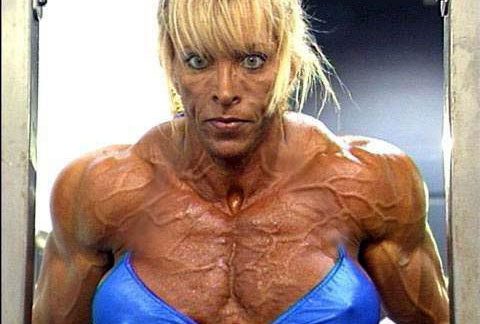
Impossible to look like this without steroids

Below are pictures of more realistic physiques that female can achieve.

Even still, a lot of the above women are professional athletes so most females won't achieve the same level of muscularity as them. But I was just proving that having muscle won't make females massive and scary.

So how does one train with a high enough intensity so that they can build muscle? Below is a simple program females can follow:

Session A

Squat 5 x 5

Bench Press 5 x 5

Row 5 x 5

Cycling

Session B

Squat 5 x 5

Overhead Press 5 x 5

Deadlift 1 x 5

Cycling

If you're too weak to use even the empty 20kg barbell for the bench press and overhead press, you can use those lighter barbells that you see people always curling with (you may need someone to help get the barbell into the correct position), or you can use dumbbells. For the squat and deadlift, there's no excuse you have to use a barbell. Be sure to research on the correct technique for these exercises before attempting them (feel free to ask me any questions in the comments section). The 5x5 or 1x5 that you see do not include the warmup sets, but if you're starting out with the empty bar, just do that for 5x5 (or 1x5 depending on the exercise). If you successful get all the reps by yourself, increase the weight for next time. Take small weight jumps.

Why am I recommending this for females? If you get stronger, you will build more muscle, thus improving your metabolism and ability to lose fat. Why are there no situps or crunches? Because when you perform the compound lifts, you need to breath into your diaphragm (think about breathing into your stomach) for more stability, which will allow you to brace your abs hard. This is enough ab work that a beginner will need.

As for the cycling, I don't mean sit on a stationary bike reading a magazine for an hour. This should last around 10 minutes tops. What you want to do is first warm up for 5 minutes, then set the resistance to a level that is moderately hard, then cycle hard all-out for 20 seconds, then rest for 10 seconds (cycling slowly and catching your breath), then cycle all-out for 20 seconds again then rest for 10 seconds (cycling slowly and catching your breath), etc until you have done this eight times. Finally, cool down for 2 minutes. This is known as Tabata training which is intense, but it will do wonders for your metabolism. However, when first starting out its best to cycle at a moderately fast pace for 10 minutes for the first week or so just to get your heart and lungs used to this.

Why is this better than cycling at a comfortable pace for an hour? Because in the 10 minutes you are cycling, you are doing intense work. This will raise your metabolism, so once you stop exercising, you will still continue to burn calories afterwards. Sounds better than cycling for an hour to me. If you have a heart condition it's probably best not to do the Tabata training.

Read the site below for more information on this:

http://www.tabataprotocol.com/

Basically you want to build up to your maximum heart rate (220 minus your age), and once you do reach it, next time increase the cycling resistance and build your way up again. You don't have to reach your maximum heart rate every time, you just want to build up to it say every 2 or 3 cycling sessions.

This program sounds like hard work, and it is. But hard work brings results. Take photos and measurements every fortnight to track your progress. I will be honest there are different ways of achieving the results you want, but through hard work and consistency you will get there. The more you put in, the more you will get out. The next post will cover diet.

One last thing, if you are going to the gym for the first time don't bother with the personal trainers, or you run the risk of them making you do stupid exercises like this:

Dumb and Dumber


Sources:
http://www.tabataprotocol.com/
http://blogs.wsj.com/health/2008/08/13/the-michael-phelps-diet-dont-try-it-at-home/
http://www.muscleprodigy.com/michael-phelps-workout-and-diet-arcl-1142.html

Failure...

...don't be afraid of it. Every once in a while, you will fail during a set on a certain exercise. You better be prepared for when it happens:


Do you think before attempting the set that I was worried about failing? I'll be honest I didn't feel my best before that set, but I focused on trying my best. I was aiming for 5 reps but I got 4, not bad for not feeling too good. If I was worried about failing I'd be lucky to get 2 reps out of that set. Your willpower gives you strength. Training isn't easy, if it was, everyone would be strong. You gotta bust your ass to reap the rewards.

Here's how to fail safely on the main compound lifts:

Squat

As in the video above, simply lower yourself until the bar lands on the safety pins. Before squatting you will need to make sure the safety pins don't touch the bar when you are in the bottom position of the squat, yet aren't too low so you can lower the bar onto the pins safely if you need to. Note that I said lower the bar, not drop it. What this means is even if you have failed, keep your body tight and keep gripping the bar hard and ease onto the safety pins, don't drop down suddenly.

Bench Press

Before I talk about how to fail on the bench press, I should say something about spotters. The only time their hands touch the bar is when helping you to rack the bar when you were unable to complete a rep on your own. From that point on the set is finished. Countless of times I have seen people benching whilst the spotter had their hands on the bar during the entire set. This is an incredibly stupid way to bench because you have no idea how strong you really are unless you perform the reps unassisted. This goes for the squat also. Don't be those guys who go bragging to their mates about how much they're benching despite the spotter helping with the rep.

Anyway back on topic. The role of the spotter is to help you safely rack the bar when you fail to complete a rep. Its best to have a spotter for the bench press during your work sets (i.e the weight you are benching 5x5 or 3x5 with). During a successful bench press set, the spotter shouldn't have had to touch the bar at all. If you're benching real heavy weights that are hard to unrack by yourself, you can ask for a hand-off (or lift-off) where the spotter helps you unrack the bar, then allows you to perform the set on your own. Be sure to establish a signal that you will use when you cannot complete the rep, it could be saying 'help' or shaking your head. Once the spotter helps you lockout the bar, rack it. The set is over. Try the weight again for the next bench session. If you still don't get all the reps (on your own) on your third attempt at that weight, deload by 10% and work your way back up.

Be honest with yourself. To be successful with a strength program, you need to know if you are getting stronger. If you keep increasing the weight but the spotter is helping you with all the reps, you do not know if you are getting stronger. Hell, the spotter could be pulling the bar harder. I've seen many spotters do what resemble upright rows when spotting the bench press whilst exclaiming "its all you man!" Train for results, not your ego.

Overhead Press

Failing on the overhead press is simple. Lower the bar back onto your shoulders then rack the weight. Easy as pie.

Deadlift

Failing on the deadlift is even simpler. Lower the bar back on the ground gently without compromising your back.


----------

A few words need to be said about training to failure. For a beginner, training to failure is plain stupid. A beginner is still developing a feel for correct technique. As you near failure, the technique will breakdown. A beginner who has not properly developed their technique will have terrible form when near failure and run the risk of getting injured.

As I mentioned earlier, how do you really know if you're getting better if you are always training to failure? So what if you benched 70kg for 3 reps then the spotter helped you get out an extra two reps? Wouldn't it have been better if you were able to get all 5 reps on your own?

One thing a lot of people don't understand is that you get stronger when you can recover from the stress that was placed upon your body. That is why proper diet and sleep is crucial to success on a training program. But if you keep pushing your body past its capabilities with endless assisted reps and drop sets, your body may not be able to recover in time for your next session. That's why you see a lot of people who always train to failure not making much progress. I find it sad when I see people who haven't improved at all in a year. You should make it an obligation to yourself to be better than how you were the same time last year.

Training to failure is however different to grinding out reps. When you grind a rep (hopefully this is the last rep of your set), it means you got close to failure, but you didn't fail. Grinding out reps will become a normal part of your training when dealing with heavy weights. Correct technique and willpower are a must to power through these tough reps.