Wednesday, March 28, 2012

How to Deal with Stalling

Stalling sucks. It makes you feel like crap. However training is just like life, there are ups and downs. I should clarify in this context stalling means that you've deloaded and worked your way back up but see no improvement. The first solution for being stuck on a weight (after attempting it 3 times) is to deload. If you've already tried that, continue reading.

There are several possible reasons why you are stalling. Let's address the most likely reasons:

  • Your technique sucks. This is the most common and most likely reason for beginners. I've written posts about proper technique already so check them out. Technique is important, because it ensures that the barbell travels through the most optimal path, and as the weight gets heavier and heavier, this becomes more and more important.
  • You're mentally not ready. Training strengthens your body as well as your mind. When going for a PR you need to be physically and mentally ready for it. You need to believe that you can successfully lift the weight for however many reps you're going for. Do you keep getting stuck at the same weight? Did failing once make you nervous to attempt the weight again the next session? Visualize yourself lifting the weight successfully in your head beforehand, then make that a reality. You are stronger than you think. If Olympic weightlifters and powerlifters take the time to get mentally prepared, so should you.


  • You cannot recover in time. This mainly applies to the squat (this will eventually happen to the bench press and press too), since on Starting Strength or Stronglifts 5x5 you're squatting 3 times a week. This should be the first lift to plateau since you've been increasing the weight on this exercise the quickest. Increasing the weight every session 3 times a week isn't going to work forever. Eventually your body cannot recover from the stress applied to it from say Monday's session in time to be fully recovered for Wednesday's session. There are a few options at this point:
  1. If you're doing 5x5 for squats every session, drop the volume down to 3x5. You're squatting three times a week, so 3x5 three times a week is still enough volume.
  2. Add in a light squat day. So you can do 5x5 on Monday, then perhaps 2x5 at 80% of Monday's weight on Wednesday, and then 5x5 on Friday but adding 2.5kg to Monday's weight, provided you got all the reps successfully. Eventually this will stop working and you'll need weekly programming for the squat, I'll write up another post on this to focus on this in more detail.

Don't get the wrong idea, the two suggestions I've given above are not because you're overtraining and it's time to squat heavy less frequently. It's because your body just cannot recover from the volume in time. Olympic lifters squat heavy almost everyday but they slowly build up to that level, and they don't do 5x5; they do singles, doubles and triples. Different rep ranges stress your body in different ways.

  • You're not training enough. When you see how Starting Strength or Stronglifts 5x5 are laid out, there's session A and session B in both cases. It's probably tempting to just train 2 times a week then (I would know I did it too). This may not be too much of an issue for squats and deadlifts, but the bench press and press would suffer in my opinion. Based on my own experiences, the bench press and press are pretty high maintenance. They need high enough volume otherwise they will not budge. When you follow the program as laid out, in a fortnight the bench press and press would each be trained 3 times. If you only train 2 times a week, the bench press and press would only be trained 2 times each in a fortnight. I think this is not enough for beginners. Remember the point of training is to adapt to higher workloads.
  • You're not microloading on the upper body lifts. Since smaller muscle groups are primarily involved in the upper body lifts compared to the lower body lifts, it makes sense that the upper body lifts will stall easier. Taking 2.5kg jumps will eventually become too much. The solution? Take smaller jumps. You do this with fractional plates, pictured below. They weigh 0.5kg, so you can increase the weight on the bar by 1kg. Use these in between each 2.5kg increase of weight, and you'll reduce the chances of stalling; e.g 60kg, 61kg, 62.5kg, 63.5kg, 65kg, 66kg, 67.5kg, 68.5kg, 70kg. Fractional plates can be bought online and they're pretty cheap.

Get a pair of fractional plates

  • You're not recovering properly. This is different to the previous point about recovery. Unlike the above point, this aspect of recovery is in your control. I'm talking about eating and sleeping. If you're not doing enough of both, your training will suffer. If you're bodyweight isn't steadily climbing, or you're not noticing any improvement in your musculature you need to eat more. Also make sure you're getting around 8 hours of sleep each night.

Well that's pretty much all I can think of, hopefully from this post you've identified possible reasons as to why you're stalling and now know how to address them.

Tuesday, March 27, 2012

Recent Lifting

This was all done last Friday

Squat:


Bench:


I was just testing my 1RM that day, usually I do sets of 5 for training. The bench press isn't one of my best lifts, but it's been slowly improving. I use a big arch to negate the effects of having long arms, and no using a big arch doesn't hurt your back.


Deadlift:


I'm not posting this because I think I'm strong and want to show off, it's just to show a glimpse of my training to whoever's interested.

Saturday, March 10, 2012

Is Lifting Heavy Weights Bad For You?

Time to put this argument to an end. When you've been training for a while, you're bound to get comments from people whether it be friends or even strangers in the gym, who will say 'don't do this exercise, you'll ruin your back/knees/whatever'.

I've said this a few times and I'll say it again, lifting weights is not bad for you, lifting weights badly is.

Look, there is risk of getting injured (although it's very small, less than 1 percent). Lifting weights is one of the safest activities you can do, why do you think athletes lift weights? There's a higher chance of injury in sports compared to lifting weights. Check out the table (scroll down) on this website to see some statistics of injuries from various activities (including lifting weights)

Provided you have done enough research on how to lift weights correctly with proper technique, you will minimize the risk of injury. When starting out you should get someone to record your sets so you can analyze your technique and see how to improve it. Read my previous posts on correct technique on the main lifts and make sure you're following those instructions correctly.

Most people who criticize you for lifting heavy weights claiming it is bad for your body or that you'll hurt yourself do not lift heavy themselves, so they should keep their opinions to themselves. Squat 250kg with good technique then come tell me its bad for your body. Anyone who can squat that much weight would know better.

I may have raised the question 'so what is bad form?'

If your squat form looks anything like in the videos below, you're doing it wrong:


  • Looks more like a good morning than a squat. Too much back extension, not bracing the abs hard enough which is making the lower back do most of the work.


  • This is how quite a lot of people squat in the gym. Not breaking parallel which puts a lot of strain on the knees, and not bending enough at the hips. These guys are the ones telling you squatting is bad for you, I wonder why?
Not knowing how to squat properly (or simply not enjoying squatting) is most likely a reason why you see a lot of people in the gym using the leg press machine. They think they're awesome leg pressing 10 plates on each side, but it doesn't compare to a heavy full depth squat. And just because you're using a machine doesn't mean it's safe, it's possible to have bad form on a machine:


  • His knees are buckled in, which places the knees in a compromising position and is an injury waiting to happen.

You should always make the effort to push the knees out, this way you'll be able to squat heavy weights safely. Watch Justin Lascek squat almost 220kg for 5 reps, pay attention to his knees, they're pushed out and don't buckle inwards during the reps. Heavy weights must be lifted correctly if you don't want to get injured. That's why it's so important to master the technique at the start when the weights are still relatively light, so once the weight gets heavy you would have developed good lifting habits.

If your deadlift looks anything like this, time to re-evaluate what you're doing:


  • Failing to keep the chest up, pulling using the back too much rather than engaging the legs. A great way to ruin your spine.

The deadlift is one of the most useful exercises you can do. It teaches you to correctly lift objects off the ground and strengthens your back in a way that no other exercise can compare. Once you can deadlift heavy weights your lower back will be rock solid.

Let the people who think lifting heavy weights is bad cower in fear when they see you lifting heavy weights. Don't get put off lifting heavy weights by people who don't even lift heavy weights themselves.


Thursday, March 8, 2012

A Beginner's Guide to Surviving At the Gym

It can be annoying training at a commercial gym, but sometimes it's the only option you have. Here's some things you need to know:

  • Most gym-goers go to the gym after they've finished work, so the gym will be most busiest at around 5-8pm. Since there will be more people at this time of the day, the chances of there being dickheads amongst them will be higher.
  • Chances are, most of these dickheads just care about training their upper body by benching a lot with bad form (butt coming way off the bench), and whenever they train their legs they probably just leg press and do quarter squats with way too heavy a weight.

Don't do this you idiot

  • These guys don't deadlift or squat heavy properly because they're afraid that they'll hurt their backs, but the ironic thing is, is that benching with bad form such as in the image above is bad for your back. Lifting badly is bad for you, lifting properly is not.
  • You may come across the occasional gym idiot who happens to be rowdy.They might even tell you the way you're training is wrong. Just ignore these people. The truth is they're insecure about themselves which is why they feel the need to prove themselves to other people. Don't bother starting any conflicts with these people, you're at a commercial gym for a reason; you have no other option so last thing you need is to get banned (if that's possible). Also, you don't want to build a bad reputation for yourself because from time to time you might need to ask for a spotter.
  • If you're a female, the chance of getting stared at will be pretty high. Just ignore it. If someone talks to you (and you don't want to be spoken to), make it clear that you're in the gym to train and not to chit-chat.
  • If you want to minimize the chance of having to deal with any dramas, go to the gym at a non-busy time like midday.

Okay now for the equipment. You want to train at a gym that has good barbells. You may not be able to tell the difference if you're handling light weights but at heavy weights it'll make a lot of difference.

This barbell has good knurling

One thing to look out for is the knurling of the barbells. If you can clearly see a criss-cross pattern along the entire barbell, it means it has good knurling. This means that you'll be able to grip the barbell effectively. If you can't see the knurling, it means the barbell is old, and if you try deadlifting heavy weights with it, you'll find it difficult to grip the bar (it'll want to slide out of your hands). If the knurling on a barbell is really obvious, like it sticks out and looks like it'd imprint dents in your hands if you gripped it, it means that the barbell hasn't been filed down properly. In terms of gripping there won't be an issue, but your hands might get sore. Try to use the same barbell every time you train.

You also want to use a barbell that has rotating sleeves (those side parts where you place weight plates on). If they can rotate easily, it'll make it easier to do exercises like the power clean and snatch as you'll be able to get under the bar easier. I'm not too sure if it makes a big difference on squats, deadlifts, presses and bench presses but it doesn't hurt to use a good barbell for those exercises too.

A trustworthy barbell brand

If you see this logo at the end of the barbell, it means it's a quality barbell. I'm not too sure about what other brands are trustworthy, but if the barbell meets the criteria above then it should be suitable. Also, a barbell with a cap on the end means that no screws will come loose (unlike on older barbells). Watch this video to see what I mean.

I know I sound picky, but if I'm going to train at a gym for a long time their equipment better be good, and you should have the same view.

If the gym is half-decent, it'll at least have a power rack (or cage), or a squat rack, pictured below.

A squat rack

If you look carefully at the safety pins, they are adjustable. You don't want a squat rack where the safety pins are fixed, like this one.

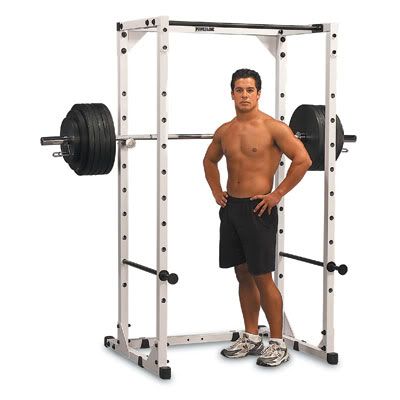
A power rack

A good power rack will have closely spaced holes, so you have a better chance of setting the barbell to a suitable height. The holes in this power rack are spaced too far apart just to give you an idea.

Now for the bench. It's better if the cushioning of the bench is minimal. If the bench looks like its comfortable enough for you to sleep on, or if the cushioning is squishy, it's probably too soft. The reason you want a hard bench is because you'll have an easier time getting into a tight setup, and you'll feel more tight too. It's the same reason why you should squat in hard flat soled shoes, so all the force gets transmitted to the bar, instead of the cushioning absorbing some of it.


A good gym has a lifting platform

If your gym has a lifting platform, that's great. Most university gyms have lifting platforms. It means you have a place to deadlift and power clean. Your gym should also have bumper plates if it has a lifting platform. Use these bumper plates for deadlifting and power cleans, so when the barbell hits the ground it won't get damaged since the bumper plates will absorb the force. Don't just drop the barbell though, lower it with some control.

Most commercial gyms won't have a lifting platform or bumper plates, but that doesn't matter you can still deadlift on the floor. If the gym doesn't allow heavy deadlifting, find another gym.

Some other things to remember:

  • Bring a towel to the gym so you can place it on a barbell or bench you're using
  • Bring a bottle to fill up, so you won't have to keep walking to the water foundation whenever you want to drink
  • In terms of how to actually train, read my other posts
  • When asking for a spotter on the bench press, make it clear that they should not touch the bar unless you cannot complete the rep on your own. Establish a signal with them that you can use to let them know when to step in to help.
  • Don't waste your time on machines.
  • Don't feel intimidated at the gym. Everyone has to start from somewhere.

Good luck.

Saturday, March 3, 2012

Assistance Exercises for Beginners

After you've been training for a while, you may find it necessary to add in some assistance work. This is because it is no longer enough to just do the main lifts to get stronger, and you need some extra work to bring up the main lifts. Since the point of assistance exercises are to assist the main lifts (squat, bench press, overhead press, deadlift), we don't want to do any exercises which won't have any benefit.

An effective assistance exercise trains the same muscle groups involved in the main lift, but through a different range of motion.

Below is a list of the most useful assistance exercises for beginners.

Assistance exercises you should be doing:
  • Ab work: any ab exercise besides situps and crunches. Prone bridges, hanging leg raises and using the ab wheel are pretty good options. Train the abs hard, because if they're weak then your lower back will do more of the work in the squat, making it look more like a good morning (look it up if you don't know what this is). You can never have abs that are too strong in my opinion.
  • Barbell Rows: if you're benching, then you have to do this exercise, no excuses. The bench press hits the front deltoids (front of the shoulders), whilst the barbell row hits the rear deltoids (back of the shoulders) thus balancing out the stress placed on the shoulder. The barbell row also trains the lats, and will give you a thicker back. All reps should start from the floor, and keep your torso as parallel to the floor as possible for all reps, if you're almost vertical when you're rowing, lower the amount of weight. You should be able to row roughly how much you're benching.
  • (Weighted) Pull-ups/Chin ups: this exercise doesn't necessarily assist the main lifts, but everyone should be doing pull-ups in my opinion. They're a great upper body exercise and will give you a wider appearance. Having strong lats will also give you a stable base to press from when you do the overhead press.

Assistance exercises you could do depending on your needs:

  • (Weighted) Dips: these are harder to do than pushups because you are supporting your entire body. If you don't have any shoulder problems do this exercise. Dips target the chest, shoulders and triceps, making it an assistance exercise for both the bench press and overhead press, which is pretty good. You need to be doing these with weights for this exercise to be beneficial to the bench press and overhead press however. You should eventually be able to dip with more weight (bodyweight + how much weight is strapped on) than you can bench press.
  • Good Mornings: this exercise can help with the squat and deadlift because it trains the posterior chain (lower back, glutes and hamstrings). No need to use heavy weights for this exercise, you want to perform quality reps otherwise you won't get anything out of this movement. Keep the reps relatively high, 3 sets of 10 reps with a weight light enough to allow you to maintain good form.

The following guideline should be useful for beginners to determine which assistance exercise to do depending on their needs:
  • If your bench press is about 80% of your squat, you need to work on your lower body more e.g. if you're benching 100kg but only squatting 120kg, your lower body is weak in comparison to your upper body. Do good mornings at the end of your session.
  • If your bench press is about 50% of your squat, you need to work on your upper body more e.g. if you're benching 70kg but squatting over 140kg, your upper body is weak in comparison to your lower body. Do dips at the end of your session.

Typically guys with short arms will be better at benching, but worse at deadlifting and will fall into the first category. Guys with long arms will be better at deadlifting, but worse at benching and will fall into the second category. I compare the squat with the bench press in those guidelines because the squat isn't really affected by how long your arms are, making it a good reference point.

For the good morning people, your routine would look like this:

Session A

Squat

Bench

Row

Good Morning

Session B

Squat

Overhead Press

Deadlift

Pull-ups/Chin-ups

For the people doing dips, your routine will look like this:

Session A

Squat

Bench

Row

Dips

Session B

Squat

Overhead Press

Deadlift

Pull-ups/Chin-ups


I bet some of you can't do dips or pull-ups however. I know I couldn't when first starting out. Here's a simple way to build your strength on these movements:

During your sessions, do 10 sets of 1 rep. Space these out as far apart as you need to. Do these sets in between the sets of your other exercises. If you got all the reps successfully, add one rep to each set. If you can't get all the reps for all the sets, try again next time. The progression will look like this:

  • 10 x 1
  • 10 x 2
  • 10 x 3
  • 10 x 4
  • 10 x 5

If you can't even do one rep, do negatives. That is, jump up to the top position of the movement, then slowly lower yourself down. Don't use the assisted pull-up/dip machine.

Once you can do 10x5 you're ready to do the movement with weight strapped on. Start out with 3 x 5 with 1.25kg strapped on. Add 1.25kg next time and so on, so it'll be:

  • B.W + 1.25kg
  • B.W + 2.5kg
  • B.W + 3.75kg
  • B.W + 5kg
  • etc etc.

The weight increase is slow, but it's better this way because you won't stall as easily. If you stall with a weight 3 times, deload and work your way back up. You should be able to get up to around B.W + 20kg for 3 sets of 5 reps. If you cannot progress any further at this stage, you may wish to ramp the sets instead, e.g. B.W + 10kg x 5, B.W + 15kg x 5, B.W + 20kg x 5. Ramping the sets will allow you to handle heavier weights on the last set.